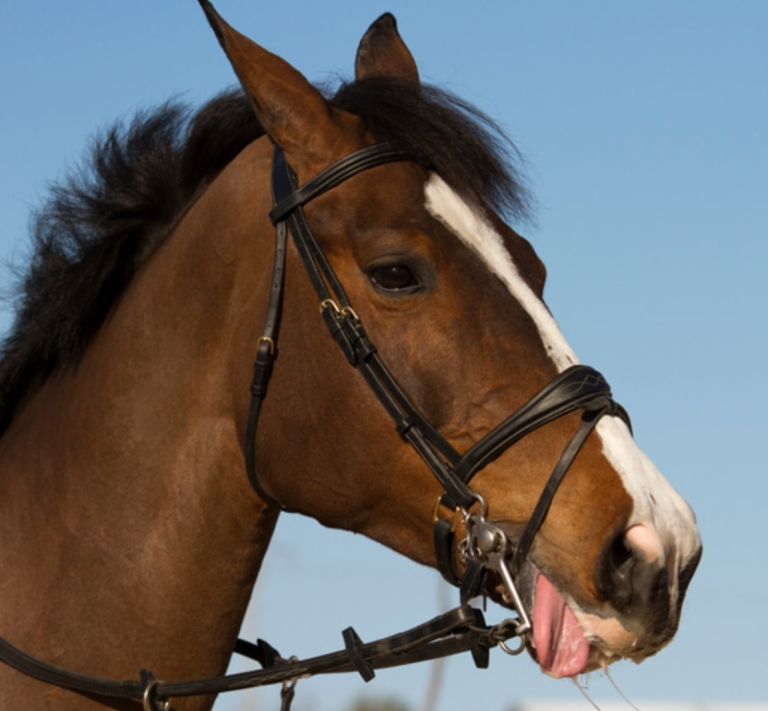
Few bitting problems are as frustrating, or as worrying, as a horse that gets its tongue over the bit. The rider suddenly loses the feel in the reins, steering and brakes become unreliable, and the horse often fusses, gapes or shakes its head. Many riders reach for a quick fix — a higher bit, a tighter noseband, or a device to hold the tongue down.
Those fixes rarely solve the problem, because they treat the behaviour rather than the reason for it. A horse does not put its tongue over the bit to be difficult. In the vast majority of cases, it is telling us that something in its mouth is uncomfortable.
What happens when the tongue goes over the bit
In a comfortable mouth, the bit rests across the tongue and on the bars, with the tongue lying underneath it. The tongue acts as a cushion, spreading the pressure of the rein aid.
When the horse draws its tongue back and lifts it over the mouthpiece, that cushion is lost. The bit now presses directly onto the bars of the lower jaw, which are covered by only a thin layer of gum, and the rider's aids become unclear or painful. The horse may also find it harder to swallow and, at speed, a tongue that is out of its normal position can interfere with breathing.
In other words, getting the tongue over the bit is usually the horse's attempt to escape one discomfort, which then creates another.
The most common causes
The bit sits too low
A bit that hangs low in the mouth leaves room for the tongue to slip over the top, and makes it easy for the horse to discover that it can. Bit height is set by the cheekpieces, and it is worth checking where the bit actually sits on the bars rather than relying on the two-wrinkle rule, which can leave some horses with the bit too low.
The bit is the wrong width
A bit that is too wide slides from side to side, changes position under contact and is less stable on the tongue. That instability gives the horse both a reason and an opportunity to move its tongue. A bit that is too narrow pinches the lips and is equally unsettling. Our article on bit width and thickness explains how to check the size.
The bit compresses the tongue
When the mouthpiece is too thick for the space in the horse's mouth, or the horse has a thick, fleshy tongue, the tongue is squashed every time the rein is taken up. Moving the tongue over the bit is one of the most direct ways a horse can relieve that pressure. A single-jointed bit can add to the problem, as the joint folds into the tongue under contact.
Our article on how mouth anatomy affects bit choice looks at tongue thickness and palate height in detail.
Dental discomfort
Sharp enamel points, ulcers, wolf teeth or other dental problems can make any bit pressure uncomfortable, and the horse may move its tongue to avoid it. A routine dental check by a BAEDT-qualified equine dental technician or vet should always be part of investigating a bitting problem.
A contact the horse cannot escape
A strong, fixed or unsteady contact gives the horse no release from bit pressure. Horses learn quickly, and if moving the tongue brings relief, they will repeat it. This is why a rider's hands and a horse's training are as much a part of the picture as the bit itself — a theme we explore in a bit is only as harsh as the hands.
Habit, youth and tension
Young horses learning to accept a bit sometimes play with their tongues and discover they can lift them over the mouthpiece. Anxious or tense horses may do the same. Once the behaviour has been established, it can persist as a habit even after the original cause has been resolved, which is why patience matters as much as equipment changes.
Why tongue ties and tighter nosebands aren't the answer
Tying the tongue down, or tightening the noseband so the horse cannot open its mouth, may stop the tongue going over the bit, but neither addresses the reason the horse is doing it. Both also carry welfare concerns of their own.
Tongue ties have been banned under FEI rules since 2004, and tongue straps are not permitted under British Dressage, British Eventing or British Showjumping rules. Research has found that applying a tongue tie causes behavioural and physiological signs of stress, and that horses who had worn one before showed a stronger response, suggesting they anticipated it as unpleasant. You can read a summary of the tongue tie research here.
Over-tightened nosebands have similar problems. Research shows they reduce chewing, licking and swallowing and can trigger a stress response, as explained in our article on saliva, swallowing and bridle fit.
Raising the bit is a more reasonable first step, and a bit that was genuinely too low may well need to come up. But pulling it up into the corners of the mouth simply to block the tongue creates new discomfort, and often does not work for long.
How to help your horse
Start by ruling out pain. Have your horse's teeth checked, and look for sores, cuts or rubs at the corners of the lips and on the tongue.
Then look carefully at the bit. Check that it is the right width for the mouth, that it sits at the correct height on the bars, and that it stays stable under a light contact as well as at rest — our guide to assessing bit fit under contact explains how.
Consider whether the mouthpiece is too thick for the space available, and whether a shape that gives more room for the tongue would suit your horse better. Shaped or low-profile mouthpieces, and designs with a degree of tongue relief, can help many horses — provided the palate is high enough to accommodate them.
Check the bridle too. A bridle that does not sit level, or a noseband that is either too loose to give stability or so tight it restricts the jaw, can both contribute.
Finally, look at the contact. A steady, elastic contact that gives the horse a release when it softens takes away the reason to evade. If the habit is established, it may take time and consistent, quiet riding for the horse to trust that it no longer needs to escape the bit.
A note on what this does and does not mean
Not every horse that occasionally moves its tongue has a serious problem. Some tongue movement is normal, and many horses play with the bit briefly when it is first put in. What matters is whether the tongue is regularly going over the top, and whether the horse shows other signs of discomfort.
Nor is there a single bit that cures the problem. The right solution depends on why your particular horse is doing it, which is why a careful assessment is far more effective than trying bit after bit.
Key takeaways
✔ A horse putting its tongue over the bit is usually escaping pressure or discomfort, not misbehaving
✔ Common causes include a bit that is too low, the wrong width, too thick, or a poor match for the horse's mouth
✔ Dental problems and a strong or unyielding contact are frequent contributors
✔ Once learned, the behaviour can become a habit even after the cause is resolved
✔ Tongue ties are banned in FEI and British affiliated sport and are linked to stress; over-tight nosebands are not a solution either
✔ Rule out pain, check bit size, height and shape, review the bridle and contact — then give the horse time
Need help solving a tongue problem?
If your horse regularly gets its tongue over the bit, a professional assessment can identify why — and find a bit and set-up that gives your horse no reason to escape.
The Fitted Horse's bit and bridle fitting consultations assess your horse's mouth, current bit and bridle, and include watching your horse ridden so the problem can be seen as it happens.
Book a bit fitting consultation →
Further reading: How mouth anatomy affects bit choice | Understanding tongue pressure in horses | Contact evasion in ridden horses | The connection between dental care and bridle fit | BEVA guidance on equine dentistry