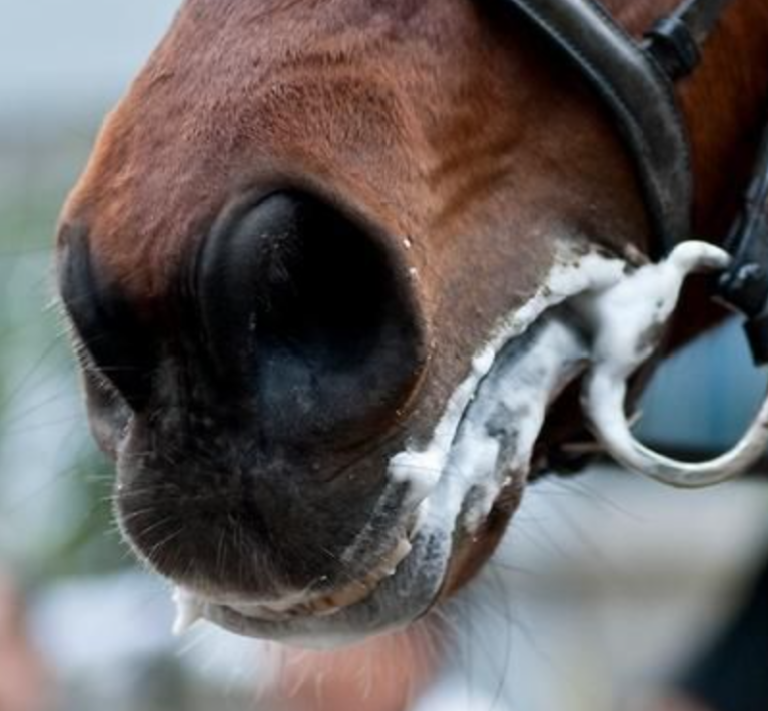
Riders often notice their horse's mouth without thinking much about what it means. Some horses work with a soft, slightly wet mouth; others stay completely dry; a few drool heavily. These differences are easy to dismiss as just the way a particular horse is, but they can tell us a good deal about how comfortable the horse is in its bridle and bit.
Saliva matters. It lubricates the mouth so the bit moves smoothly over the tongue and lips, protects the soft tissues from friction, and is essential for comfortable swallowing. How much saliva a horse produces, and how well it can swallow it, are closely linked to how freely it can move its jaw and tongue.
Why jaw and tongue freedom matter
Swallowing depends on movement. To swallow, a horse needs to move its tongue, flex its jaw slightly and form a seal with the soft palate. When that movement is free, saliva is produced and cleared naturally, and the mouth stays comfortably moist.
Anything that restricts that movement interferes with the process. A noseband that clamps the jaw shut, a bit that compresses the tongue, or tension through the poll and temporomandibular joint can all reduce the horse's ability to chew and swallow comfortably.
What the research shows about nosebands
The link between noseband tightness and oral behaviour has been studied directly.
In a 2016 study published in PLOS ONE, horses wearing a double bridle had their crank nosebands adjusted to four levels: unfastened, two fingers of space, one finger, and no space. Chewing decreased significantly with one finger of space or less, and licking stopped entirely at the tightest setting. At that setting, heart rate and eye temperature rose — signs of a physiological stress response.
When the nosebands were removed, swallowing, licking and yawning increased sharply above normal levels, suggesting the horses had been prevented from doing something they were motivated to do.
Overly tight nosebands are also common. A 2017 survey of 750 competition horses found that 44% had nosebands fastened so tightly that no fingers could fit beneath them, and only 7% met the traditional two-finger guideline.
The International Society for Equitation Science recommends that at least two adult fingers' space is left at the front of the nose, and has developed a taper gauge to measure it consistently.
When a horse's mouth is too dry
A dry, sticky mouth in a ridden horse often reflects restricted jaw movement or tension. The most common bridle-related causes are a noseband or flash that is too tight, a bit that compresses the tongue and makes swallowing awkward, and a bridle that creates pressure or discomfort at the poll, leaving the horse braced rather than relaxed.
Stress plays a part too. Just as people get a dry mouth when anxious, a horse that is tense or uncomfortable may produce less saliva and swallow less often. It has also been suggested that pressure around the throat and the area behind the jaw, where the large parotid salivary glands sit, could play a role; the evidence for this is less clear, but it is one more reason to make sure the throatlash and headpiece are comfortable in that area.
Many horses show a noticeable increase in saliva and a softer mouth once the noseband is loosened or the bridle is refitted, which is often the clearest sign that restriction was the issue.
When a horse drools excessively
Excessive drooling can be harder to interpret. In some ridden horses, it happens because the horse is producing saliva but cannot swallow it effectively — often because the noseband is too tight or the bit is holding the tongue down — so saliva escapes from the lips instead. This is different from the soft, moist mouth of a comfortable horse; it tends to come with tension, a fixed jaw or a fussy contact.
Other possible causes include a bit that irritates the mouth, discomfort from the bridle or bit causing the horse to mouth constantly, and some horses' individual response to particular bit materials. Our complete guide to bit mouthpiece materials looks at materials in more detail.
What to check
If your horse's mouth seems unusually dry or wet, start with the noseband. Check that two fingers fit comfortably beneath it at the front of the nose, that it sits in the right position relative to the facial crest and nasal bone, and that any flash is not drawn tighter than the noseband itself. Our complete guide to nosebands covers fit and position for each type.
Then look at the rest of the bridle and the bit. Is the headpiece comfortable around the poll and behind the ears? Are the cheekpieces level? Is the bit the right width and thickness for the horse's mouth, sitting at the right height, and stable under contact? Often a single adjustment makes a noticeable difference.
A note on what this does and does not mean
Not every change in salivation is caused by the bridle. Dental problems, mouth ulcers or injuries can all affect saliva and swallowing, and some horses drool heavily after grazing certain pastures. Sudden excessive salivation — particularly with food or saliva coming from the nostrils, coughing or distress — can be a sign of choke and needs a vet urgently.
If a change in your horse's mouth is new, marked or comes with other signs of illness, speak to your vet before assuming it is a fit issue.
Nor is a dry mouth or a wet mouth automatically a problem. Horses vary, and what matters most is the overall picture: a relaxed jaw, a soft expression, regular swallowing and a settled contact.
Key takeaways
✔ Saliva lubricates the mouth and depends on the horse being free to move its jaw and tongue
✔ Research shows tight nosebands reduce chewing and licking and can cause a physiological stress response
✔ A very dry mouth often points to restriction or tension; check the noseband first
✔ Excessive drooling can mean a horse cannot swallow effectively, often due to a tight noseband or the bit holding the tongue down
✔ Two adult fingers' space at the front of the nose is the widely recommended minimum
✔ New or marked changes in salivation, especially with nasal discharge or distress, need a vet
Want a second opinion on your horse's bridle?
If your horse's mouth is unusually dry, drools heavily, or never seems quite relaxed in the contact, a bridle and bit assessment can help pinpoint whether fit is part of the picture.
The Fitted Horse's bridle and bit fitting consultations assess noseband fit, jaw freedom and bit comfort together, and recommend changes that let your horse chew and swallow naturally.
Book a bridle fitting consultation →
Further reading: The complete guide to nosebands | Why your horse needs a noseband | How mouth anatomy affects bit choice | The effect of noseband tightening (PLOS ONE, 2016) | ISES taper gauge