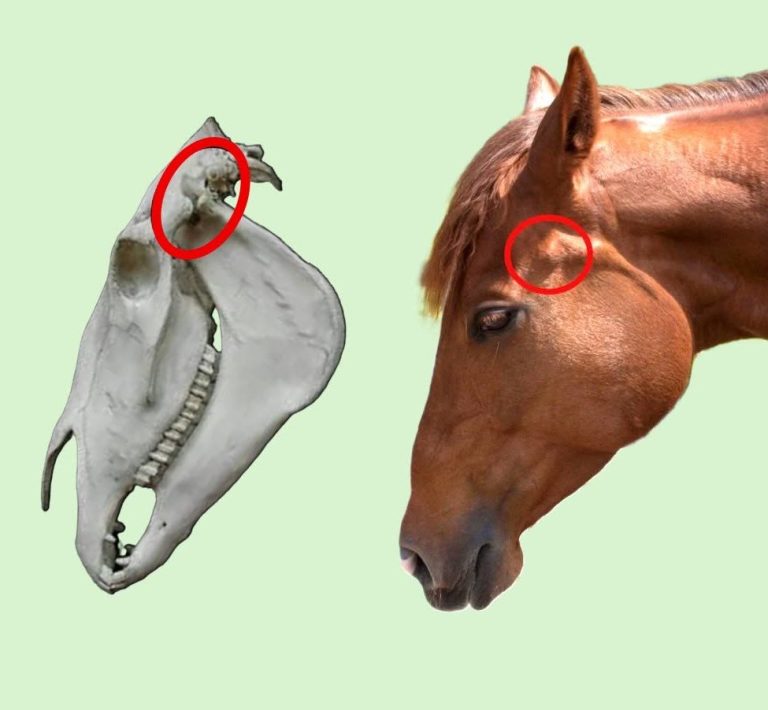
Most riders are familiar with the poll and the withers. Far fewer have heard of the temporomandibular joint, even though it sits in one of the busiest areas of the bridle and plays a central part in how comfortably a horse accepts the bit and contact.
It is a small joint, but it matters. When it can move freely, the horse can chew, swallow and soften its jaw. When it cannot, the effects tend to spread well beyond the head.
Where is the TMJ?
The TMJ is the joint between the lower jaw (the mandible) and the temporal bone of the skull. On each side of the head, you can find it just in front of the base of the ear and slightly below it. If you trace the bony ridge that runs back from below the eye towards the ear — the zygomatic arch — the TMJ lies at the back end of that ridge, just in front of the ear. Placing your fingers there and offering your horse a treat, you can often feel the joint moving as the horse chews.
Inside the joint, a disc of fibrocartilage sits between the two bones, acting as a cushion and allowing smooth movement. Around it are the ligaments that stabilise it and the powerful chewing muscles that move the jaw, including the large masseter on the side of the face.
What the TMJ does
The horse's jaw moves in more directions than most people realise. It opens and closes, moves from side to side as the horse grinds its food, and slides slightly forwards and backwards. All of this happens at the TMJ.
Those movements are essential not only for eating but for riding. A horse needs to be able to move its jaw to chew and swallow saliva, to position and work the bit with its tongue and jaw, and to soften and relax in the contact. The jaw, poll and neck are closely linked through muscle and fascia, so tension in one tends to show up in the others. Flexion at the poll itself happens at a different joint — between the skull and the first vertebra of the neck — but a horse with a tight, clamped jaw rarely flexes softly at the poll.
How the bridle can restrict the TMJ
Several parts of the bridle sit close to the TMJ or influence how freely the jaw can move.
A noseband that is too tight
This is the most common cause of jaw restriction. A noseband or flash fastened too tightly holds the jaw closed, so the TMJ cannot move through its normal range. A 2016 study in PLOS ONE found that horses chewed significantly less when their nosebands were tightened to one finger of space or less, and stopped licking altogether at the tightest setting, alongside signs of a physiological stress response. A 2024 study in the Equine Veterinary Journal also found that pressure beneath a cavesson was higher over the lower jaw than over the nasal bone, and rose as the noseband was tightened.
A noseband in the wrong position
A noseband sitting too high, tight against the facial crest, has little room to move with the jaw. One sitting too low can press on softer tissue and interfere with the jaw and nostrils. Each type of noseband has its own correct position, which our complete guide to nosebands explains.
Buckles and joins over the joint
On many bridles, the cheekpiece buckles and the join between headpiece and browband lie close to the TMJ. Where a buckle or thick join sits directly over the joint, it creates a concentrated pressure point every time the jaw moves. Adjusting the cheekpieces so the buckles sit higher or lower, or choosing a bridle with buckles in a different position, can make a real difference. Our article on why cheekpiece length and position are critical explains how to set them.
A headpiece or browband pulling into the ears
A browband that is too short pulls the headpiece forward against the back of the ears, crowding the area around the TMJ. Pressure-mapping research by Dr Rachel Murray and colleagues found that one of the highest pressure zones under the bridle was at the base of the ears where the browband attaches to the headpiece, an area that corresponds to the TMJ. You can read more in our article on browband fit and in this overview of the research on Horse Sport.
An uneven bridle
Cheekpieces set at different heights, or a bridle that sits crooked on an asymmetrical head, can load one side of the jaw more than the other. Over time, that can contribute to the horse feeling stiffer on one rein than the other.
Signs that the jaw may be restricted
A horse with a restricted or uncomfortable jaw can show it in many ways, and the signs are often mistaken for training or attitude problems.
Around the head, you may notice reluctance to be bridled or to open the mouth for the bit, a clenched or set jaw, tension in the muscles of the face and around the eyes, a dry mouth or, conversely, drooling because swallowing is difficult, head tossing, and gaping or crossing the jaw.
Under saddle, signs can include resistance to the contact, a horse that feels "dead" or unresponsive to the rein aids, tension through the neck, difficulty flexing and bending, one rein feeling noticeably stiffer than the other, shorter strides, hollowing through the back and a loss of impulsion.
None of these signs is specific to the TMJ — they can have many causes — but when several appear together, it is well worth checking the bridle. Our article on saliva, swallowing and bridle fit looks at the mouth-related signs in more detail.
Why jaw tension spreads through the body
The muscles that move the jaw are linked to those that position the head and neck, and through the neck to the shoulders and the rest of the body. When a horse braces against restriction at the jaw, that tension rarely stays local. It commonly shows as tightness at the poll and through the top of the neck, which then affects how the horse uses its shoulders, back and hindquarters.
This is one reason the 2015 bridle pressure study found differences in knee and hock flexion when peak pressures beneath the headpiece and noseband were reduced. A horse that is comfortable at the head is far better able to move freely through its whole body.
Checking your horse's bridle for TMJ freedom
With the bridle on, start with the noseband. Check that at least two fingers fit beneath it at the front of the nose, and that it sits clear of the facial crest rather than tight against it. If you use a flash, check that it is not tighter than the noseband.
Then find the TMJ on each side and look at what sits over it. Is there a buckle, join or thick piece of stitching directly over the joint? Look at the browband: is there clear space at the base of the ears, or is the headpiece being pulled forward into them? Check that the cheekpieces are level on both sides and hang straight.
Finally, watch your horse chew. With the bridle on, offer a small treat and see whether the jaw can move freely and comfortably. A horse that struggles to chew, or seems uncomfortable doing so, may be telling you something about the fit.
What happens when restriction is removed
Many horses show a noticeable change soon after a restrictive noseband is loosened or a buckle is moved off the joint: a softer mouth, more swallowing, a looser neck and a more willing attitude to the contact. Deeper changes — releasing established tension patterns and building more even muscle — take longer and often benefit from consistent, correct work and input from a physiotherapist. The longer a restriction has been in place, the longer it is likely to take for the horse to move freely again.
A note on what this does and does not mean
Bridle fit is only one possible cause of jaw problems. The TMJ can be affected by dental issues, injury and joint disease, all of which need veterinary diagnosis, sometimes with advanced imaging. If your horse shows persistent signs of jaw pain, difficulty eating, swelling around the joint or asymmetry of the face, your vet should be your first call. Our article on the connection between dental care and bridle fit explains how teeth and the jaw interact.
Nor does this mean nosebands are inherently bad. A well-fitted noseband can help keep the bridle stable and the bit steady, as explained in why your horse needs a noseband. The aim is a noseband that supports, not one that clamps.
Key takeaways
✔ The TMJ is the jaw joint, found just in front of the base of the ear, directly beneath the bridle
✔ It allows the horse to chew, swallow and work the bit, and is closely linked to the poll and neck
✔ Tight nosebands are the most common cause of jaw restriction, and research shows they reduce chewing and licking
✔ Buckles over the joint and headpieces pulled into the ears add concentrated pressure in this area
✔ Jaw restriction often shows as tension, resistance and stiffness that spreads through the body
✔ Check noseband tightness and position, buckle placement and browband fit — and involve your vet for persistent jaw signs
Is your horse's jaw free to move?
If your horse is tense in the contact, stiff on one rein or uncomfortable at bridling, a bridle assessment can show whether the TMJ is being restricted.
The Fitted Horse's bridle and bit fitting consultations check noseband fit, buckle placement and overall bridle balance, so your horse's jaw can move as it should.
Book a bridle fitting consultation →
Further reading: Bridle fit, facial nerves and bone structure | Browband fit | The complete guide to nosebands | Contact evasion in ridden horses | Facial pressure beneath a cavesson noseband (Equine Veterinary Journal, 2024)