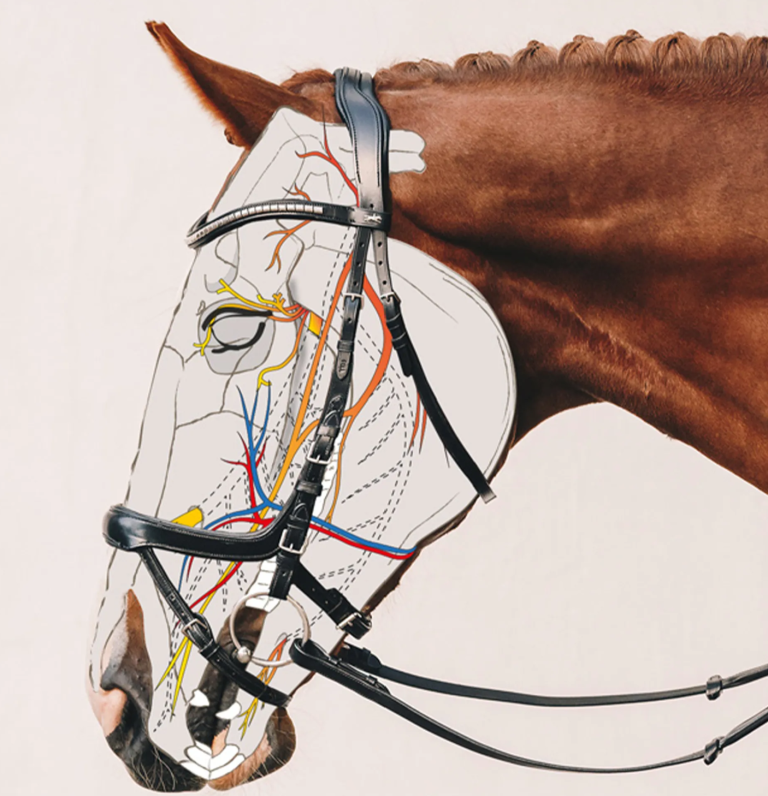
It is easy to think of a bridle as a simple arrangement of straps whose job is to hold the bit in place. In reality, every strap crosses or rests on anatomy that matters. The headpiece sits just behind the ears, close to the temporomandibular joint and the wings of the atlas. The browband lies near the base of the ears. The cheekpieces run down the side of the face over the facial crest, and the noseband sits across the nasal bones, close to where important nerves emerge from the skull.
Understanding what lies beneath the bridle explains why fit matters so much — and why a horse that seems to be "difficult" about its head is often simply telling us that something hurts.
The nerves beneath the bridle
Two cranial nerves are particularly relevant to bridle fit.
The trigeminal nerve
The trigeminal nerve is the main sensory nerve of the face. As its name suggests, it has three main branches. The ophthalmic branch supplies sensation to the forehead and the area around the eye. The maxillary branch supplies the upper face, and one of its major continuations, the infraorbital nerve, emerges onto the side of the face through a small opening in the skull called the infraorbital foramen, below and in front of the eye. The mandibular branch supplies the lower jaw, and its mental nerve emerges near the corner of the mouth through the mental foramen.
These exit points matter because, as the nerve leaves the protection of the bone, it lies just beneath the skin. A noseband set too high or too tight, a flash drawn hard across the face, or a curb chain or drop noseband pressing near the corner of the mouth can all press on these areas.
The trigeminal nerve is also involved in a condition known as trigeminal-mediated headshaking, in which the nerve becomes hypersensitive and fires in response to stimuli that would not normally cause pain. This is a medical condition rather than a fit problem, and it needs veterinary investigation — but bridle pressure can add to a horse's discomfort, and fit should always be considered alongside it. Our article on headshaking in ridden horses explains more.
The facial nerve
The facial nerve controls the muscles of facial expression, including those of the lips, nostrils, eyelids and ears. It emerges from the skull behind the jaw joint and runs forwards across the side of the face, over the large chewing muscle known as the masseter. Here it lies close to the surface, beneath the area where the cheekpieces and the side of the noseband sit.
Vets have long known that sustained pressure on this area can affect the nerve — a tight headcollar left on a horse lying down under general anaesthetic, for example, can cause temporary weakness of the facial muscles on one side. Bridle pressure during riding is very different in duration and intensity, but the principle is the same: this is an area that does not tolerate sustained, concentrated pressure well.
The blood vessels
Alongside the nerves run the blood vessels that supply the face. The facial artery and vein cross the lower edge of the jaw and run up the side of the face, and smaller vessels supply the eye, nose, lips and ears. Sustained pressure from a tight or poorly placed strap can restrict local blood flow, and over time, the skin responds. Rubbed areas, hair loss and the appearance of white hairs under bridle straps are all signs that pressure has been concentrated in one place for too long.
The bony landmarks
Bone does not compress. Soft tissue does. Where a bridle strap crosses a bony prominence, the skin, nerves and blood vessels lying over that bone are squeezed between the strap and a hard surface, which concentrates pressure into a small area.
The key landmarks are the facial crest (the bony ridge running along the side of the face below the eye), the edges of the eye socket, the nasal bones down the front of the face, the bony prominences around the base of the ears, the wings of the atlas just behind the poll, and the temporomandibular joint, where the lower jaw meets the skull.
Head shape varies considerably. Some horses have a prominent facial crest; others have very little. Some have a short distance between the eye and the ear; others a long one. Some are noticeably asymmetrical, with the ear further from the eye on one side than the other. Every one of these variations changes how a bridle sits, which is why a bridle that fits one horse well can press uncomfortably on another.
What the research shows
In a widely cited study published in the Journal of Equine Veterinary Science in 2015, Dr Rachel Murray and colleagues placed pressure mats under the bridles of 19 competition horses wearing their own well-fitted bridles. They identified six zones of peak pressure, including the back and front edges of the headpiece — behind the ears and over the front of the wings of the atlas — the area under the browband attachment, and around the noseband in relation to the facial crest. Contrary to long-held assumptions, they did not find significant pressure over the top of the poll itself; the highest pressures were at the base of the ears, close to the temporomandibular joint.
The team then designed a bridle to relieve those zones, with a shaped headpiece, padding to lift the bridle off pressure points, and a noseband designed to move with the head. It roughly halved peak headpiece pressure compared with the horses' usual bridles, and the horses showed greater flexion of the knees and hocks when wearing it. You can read a summary of the research in Your Horse and a detailed overview on Horse Sport.
The same research found that a noseband sitting tight against the facial crest had very little room to move and created more pressure, while one placed slightly lower, with a gap below the crest, reduced pressure on the noseband and headpiece together. A separate 2017 survey of 750 competition horses found that the distance between the facial crest and the top of the noseband varied from nothing at all to 70mm, showing how inconsistently nosebands are positioned in practice.
How pressure shows up in behaviour
A horse cannot tell us that a strap is pressing on a nerve, but it can show us. Common signs include reluctance to be bridled, head-shyness or flinching when the face is touched, rubbing the head on the legs or on objects, head tossing or shaking, tension through the jaw and poll, resistance to the contact, and a general inability to relax or move forward freely.
Because the jaw, poll and neck are closely linked through muscle and fascia, tension at the head rarely stays at the head. A horse that braces against bridle pressure often carries that tension through the neck and into the shoulders and back, which is one reason the 2015 study found changes in limb movement, not just in the head.
These behaviours are frequently labelled as attitude, sensitivity or a training problem. Very often, they are a direct response to discomfort that can be resolved by changing the fit of the bridle.
Fitting the bridle around the anatomy
Good bridle fitting starts with the horse's head rather than with the bridle. In practice, that means checking a number of things.
The headpiece should sit comfortably behind the ears without pressing into their base or digging into the wings of the atlas, and should ideally be shaped to give the ears room. Our articles on the anatomical bridle revolution and choosing the right anatomical bridle look at headpiece design in detail.
The browband must be long enough that it does not pull the headpiece forward into the back of the ears. The cheekpieces should hang straight and be set so that buckles do not sit over the facial crest or the eye, as explained in why cheekpiece length and position are critical.
The noseband should sit clear of the facial crest rather than tight against it, be positioned on the nasal bones rather than over the soft cartilage of the nose, and be fastened with at least two fingers' space at the front. Our complete guide to nosebands covers each type.
Any buckles, joins and stitching should lie away from bony prominences, and the bridle should sit level, with even pressure on both sides. Where the horse is asymmetrical, adjustments may need to differ from one side to the other.
Recovery once pressure is removed
When a pressure point is removed, many horses show relief almost immediately: a softer eye, a quieter mouth, less fuss at bridling. Deeper changes, such as releasing established tension patterns through the jaw, poll and neck, take longer, often several weeks of comfortable work, and may benefit from input from a physiotherapist. Where a horse has learned to anticipate discomfort, it can take time for that wariness to fade, so patience and quiet handling are important.
The longer a problem has been present, the longer recovery is likely to take, which is the strongest argument for getting fit right from the outset and checking it regularly.
A note on what this does and does not mean
This article is not a reason to worry that every bridle is causing harm. Most horses are perfectly comfortable in a bridle that has been chosen and fitted with care. The point is that the head is a sensitive, highly innervated area, so small details of fit have a real effect on comfort.
Nor is a bridle fitter able to diagnose nerve damage or pain. If your horse shows persistent headshaking, sensitivity of the face, facial asymmetry or any sudden change in behaviour around the head, your vet should be the first call. Bridle fitting then works alongside veterinary care, dental care and physiotherapy as part of the whole picture.
Key takeaways
✔ The bridle crosses branches of the trigeminal and facial nerves, the facial blood vessels and several bony landmarks
✔ Nerves are most vulnerable where they emerge from the skull and lie just beneath the skin, such as below the eye and near the corner of the mouth
✔ Pressure-mapping research found peak bridle pressures behind the ears, at the browband attachment and around the facial crest — not on top of the poll
✔ A bridle designed to relieve those zones reduced pressure and improved knee and hock flexion
✔ Pressure often shows as head-shyness, head tossing, resistance or tension that spreads through the neck and body
✔ Fit the bridle to the horse's individual head shape, and involve your vet for persistent or sudden changes
Is your horse's bridle working with their anatomy?
If your horse is reluctant to be bridled, sensitive around the face or tense in the contact, a bridle assessment can show whether pressure is part of the problem.
The Fitted Horse's bridle and bit fitting consultations assess your horse's head shape, current bridle and bit, and recommend adjustments or designs that keep pressure away from the most sensitive areas.
Book a bridle fitting consultation →
Further reading: Why a correctly fitting bridle is essential | Signs your bridle may not fit correctly | The anatomical bridle revolution | Headshaking in ridden horses | Bridle fit research summary (Your Horse)