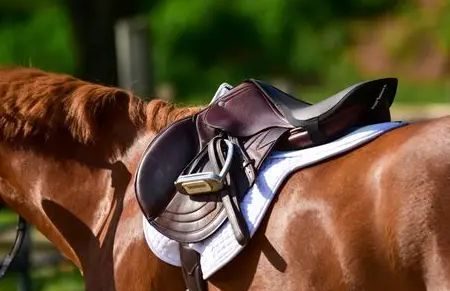
Tree shape is one of the most important decisions in saddle fitting. A saddle tree with a curve that matches the horse's back spreads the rider's weight evenly. One that does not will rock on a flat back or bridge on a curved one, concentrating pressure into smaller areas. Our article on your horse's back anatomy and saddle fit explains why matching tree curvature to back shape matters so much.
In most saddles, that tree shape is fixed. Choose a curve that suits the horse today, and the saddle is committed to that shape for as long as it is used. Duskin takes a different approach.
The problem with a fixed tree shape
A rigid tree has one curve. If that curve matches the horse, the saddle can fit very well. If it does not, flocking and padding can help at the margins but cannot change the tree's fundamental shape.
Horses also change. A young horse's back often becomes rounder as it matures and builds muscle. A horse coming back into work after time off may start flatter and fill out over months. Some horses change shape noticeably between seasons, or when their work changes. A saddle with a fixed tree may suit one stage of that journey and not the next.
How Duskin's flexible tree works
Duskin saddles are built on a tree designed to flex rather than hold a single rigid shape. It bends lengthways to follow the curve of the horse's back, so the same tree can sit evenly on a rounder back or a flatter one, and it has a degree of give from side to side that allows it to move with the horse. WOW describes it as a flex tree: supportive in all directions, but without the rigidity of a traditional tree.
It is important to understand what this is and what it is not. A Duskin is not a treeless saddle. It still has a defined structure that supports the rider and spreads their weight across the back. The difference is that the tree adapts to the horse's back profile rather than asking the horse's back to match the tree. WOW reports having pressure-tested Duskin saddles on horses that would normally need flat trees and on horses that would normally need curved trees in its rigid saddles, with good results in both cases.
In practice, this means the fitter does not need to choose between flat, semi-curved and curved trees for a Duskin, as they would for many other saddles, including WOW's rigid-tree models.
Why Duskin panels are foam, not Flair
Many owners familiar with WOW saddles ask whether a Duskin can be fitted with Flair air panels. The answer is no, and the reason comes down to how each system is designed.
Flair air panels work by allowing air to redistribute within a set of bags as the horse's back moves beneath a stable structure. That stable structure is the rigid tree: it provides a consistent framework within which the air bags can do their job. Our article on how Flair air panels work explains the system in detail.
Duskin's tree is designed to move. Combining a moving tree with air panels designed for a fixed framework would make the system less predictable, and the benefit of each would be reduced. Foam panels, by contrast, give consistent, even support that works with the tree as it flexes. So the foam panels in a Duskin are not a downgrade; they are the part of the system designed to match a flexible tree.
Duskin panels can still be changed within the Duskin range — for example to a different width or configuration — and support can be fine-tuned with shims inside the panels to adjust pressure in specific areas.
Flexible tree vs "adjustable" saddles
The word "adjustable" is used widely in saddle marketing, and it can mean very different things. Our article on why adaptive saddle technology matters explores this in more depth.
In many saddles described as adjustable, what can be changed is the width at the front of the tree, usually through an interchangeable gullet plate or headplate. That is genuinely useful, because it allows the fit at the withers and shoulders to be altered as the horse changes. But the curve of the tree, the panel shape and the saddle's length usually stay the same. If the horse's back becomes rounder or flatter, a front-width adjustment alone cannot correct the mismatch.
A Duskin offers adaptability at several levels. The flexible tree adjusts to the back's curvature. Interchangeable headplates adjust the fit at the withers and shoulders. Panels can be exchanged within the Duskin range, and shims can fine-tune pressure within the panels. Together, these allow the saddle to follow a wider range of changes in the horse's shape.
Which horses might suit a Duskin
A flexible tree can be particularly useful for young and developing horses whose backs are likely to change shape; horses whose shape varies with season, fitness or workload; horses that sit between tree profiles, or whose owners have struggled to find a rigid tree that suits; and owners looking for an adaptable saddle at a more accessible price point than WOW's fully modular rigid-tree saddles. Duskin saddles are available in several styles, including dressage, general purpose, jumping and cross-country designs.
Our article on is a Duskin right for you and your horse? looks at the practical considerations in more detail.
When a rigid tree may still be the better choice
A flexible tree is not automatically better for every horse. Some horses and riders benefit from the precise, fine-tuned support of a rigid tree combined with adjustable Flair air panels, particularly where a horse has marked asymmetry that needs different settings on each side, very specific shape requirements, or the rider wants the maximum degree of modular configuration. In those cases, WOW's rigid-tree saddles may be more suitable. Our article on WOW Competitor vs DMK compares WOW's rigid-tree ranges.
The right choice depends on the individual horse, the rider and the work, which is why a fitting with both options available is so useful.
Fitting still matters
A flexible tree reduces the need to choose a tree curvature, but it does not remove the need for a professional fitting. The headplate still needs to suit the withers and shoulders, the panels need to suit the width and length of the back, the saddle needs to sit in balance with the rider on board, and the fit needs checking regularly as the horse changes. Our article on how often your saddle should be checked gives guidance.
A note on what this does and does not mean
The flexible tree is a genuinely different approach to saddle design, but no saddle is right for every horse. A Duskin will not suit a horse if the rest of the configuration — headplate, panels and balance — does not, and some horses will be better served by a rigid tree with air panels or by a well-fitted traditional saddle.
Nor can any saddle compensate for pain or lameness. If your horse shows back sensitivity, reluctance to work or a saddle that consistently slips to one side, your vet should be involved alongside your saddle fitter.
Key takeaways
✔ Duskin saddles use a flexible tree that adapts to curved, semi-curved and flat backs without tree swaps
✔ It is not treeless: it still supports the rider and spreads weight, but follows the horse's back profile
✔ Duskin panels are foam because foam works with a moving tree, while Flair air panels are designed for a rigid tree
✔ Many "adjustable" saddles only change the front width; Duskin adapts curvature, headplate and panels
✔ A flexible tree can suit young, changing and between-profile horses, at a more accessible price point
✔ Professional fitting is still essential, and some horses are better suited to a rigid tree with Flair
Would a Duskin suit your horse?
If your horse's back shape changes, or you have struggled to find a tree that fits, a Duskin demo can show you how a flexible tree sits on your horse.
The Fitted Horse's WOW saddle fitting consultations can include both Duskin and rigid-tree WOW options, so you can compare them on your own horse and choose the one that suits it best.
Book a saddle fitting consultation →
Further reading: Your horse's back anatomy and saddle fit | Flat backs and saddle fit | Why adaptive saddle technology matters | Is a WOW saddle right for you and your horse?