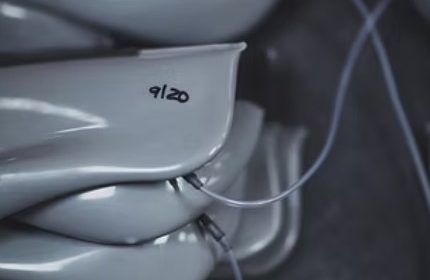
Once a saddle is girthed up, its panels are out of sight, and it is easy to assume they simply sit there doing the same job from the moment the rider mounts to the moment they dismount. In reality, the horse's back is never still. It lifts, flexes and swings with every stride, the shoulder blade rotates backwards beneath the front of the saddle, and the long back muscles either side of the spine contract and release continuously. The panels are the only part of the saddle in contact with all of that movement.
How those panels respond — or fail to respond — has a direct effect on how freely the horse can move, how evenly the rider's weight is carried, and how the horse's muscles develop over time. Flair air panels, used in WOW Saddles, were designed specifically to allow the panel to respond to the moving back rather than presenting it with a fixed surface.
This article explains how Flair panels are built, how they differ from wool and foam, and why responsive support matters for the way a horse moves. It also sets out, honestly, what Flair can and cannot do.
Firm support, not soft cushioning
The most common misunderstanding about air panels is that they must be soft. The word "air" suggests something squashy, and many riders assume an air-panelled saddle works by cushioning the back. It does not — and if it did, it would not work well.
A horse's back needs firm, even support to carry a rider's weight efficiently. Panels that are too soft compress under load, lose their shape and stop distributing weight properly; in effect, they bottom out. Flair panels are therefore set up to be firm. What distinguishes them is that they are firm and responsive, rather than firm and rigid.
It is useful to separate three kinds of support. Hard, rigid support holds its shape but cannot respond to movement. Soft, compressible support may feel comfortable initially but flattens over time and loses its ability to spread load. Firm, responsive support holds its shape under weight yet shifts and redistributes as the back moves beneath it. Flair is designed to provide the third. Air is simply the medium that makes that responsiveness possible; the firmness is deliberate.
How a Flair panel is constructed
In a Flair saddle, traditional wool flocking is replaced by four large air bags — two on each side — running along the length of the panels. A foam core gives each panel its basic shape and provides a degree of shock absorption, while the air bags provide the responsive support that sets the system apart.
The four bags are designed to function as a single system rather than four separate cushions. When pressure increases in one area, air redistributes across the panel, so the rider's weight is spread over the whole contact area rather than concentrating at particular points. A single air bag would tend to create its own pressure points; four working together spread the load.
Each bag is inflated by a trained fitter to suit the individual horse's back, together with the rider's weight and position. Pressure can be increased or reduced at the yard, with the saddle on the horse, and each bag can be set independently. Unlike wool, Flair does not settle or pack down with use. This means the saddle should be balanced correctly from the first fitting, rather than flocked slightly high in anticipation of compression, and it should stay that way until the horse's shape changes.
Static and dynamic panels: wool, foam and air
The meaningful difference between panel types is not the material itself but whether the panel is static or dynamic. A static panel is shaped once and keeps that shape; the horse moves beneath it. A dynamic panel changes the way it distributes pressure as the horse moves.
Traditional wool flocking is static. It compresses under the rider's weight and, over weeks and months, gradually stays compressed. Pressure tends to fall on the same areas stride after stride, and as the wool packs down those areas can become more concentrated. Wool can be adjusted, including differently on each side, but only by a fitter re-flocking the saddle, and it begins to settle again from the moment it is ridden in.
Foam panels, such as those used in Duskin saddles, are more stable than wool. They resist compression better and stay consistent for longer, which makes them a practical and reliable choice for many horses. They are still static, however: the pressure pattern is largely set by the panel's shape rather than by what the horse is doing.
Flair is dynamic. Because the air can move within and between the bags, pressure shifts with the back, shoulder and spine rather than remaining fixed. The support stays firm, but it is never locked into one pattern.
None of this makes wool or foam saddles poor choices. A great many horses work comfortably in well-fitted, well-maintained traditional saddles. Flair adds a degree of responsiveness that static systems are not designed to offer, and for some horses that responsiveness makes a real difference.
How responsive panels support the moving back
A horse working correctly lifts through the back to carry the rider. Beneath a static panel, that upward movement meets a fixed surface, so the horse is effectively lifting against the saddle. Beneath a Flair panel, air shifts as the back rises, supporting the lifted position rather than resisting it. Over time, a back that is able to lift freely is far better placed to build correct topline muscle.
Collection asks for more of the same: greater engagement of the hindquarters and a further lift through the back. This is precisely the point at which a rigid panel is most likely to interfere. Riders moving to Flair frequently describe collection as feeling easier and more established, and a large part of the reason is that the horse is no longer working against the saddle to achieve it.
In extension, the horse lengthens the frame and reaches further through the shoulder. A static panel is shaped for one back position, which can limit how much the horse is prepared to open up. A responsive panel accommodates the change in shape, and the result is often a longer, freer stride.
The shoulder deserves particular attention. With every stride, the scapula rotates backwards beneath the front of the saddle. If the front of the panel cannot accommodate that rotation, the horse shortens the stride to avoid discomfort — a pattern that can easily be mistaken for laziness or a training issue. Flair's front air bags adjust as the shoulder moves, so pressure shifts rather than pinches.
The changes riders commonly report — longer and more rhythmic strides, a more engaged feel, better response to the leg and a softer contact — are not a sign that the horse is trying harder. They reflect a horse that is physically more able to move well.
Accommodating asymmetry in horse and rider
Very few horses are symmetrical. Most have a stronger side, in much the same way that people are right- or left-handed. Others carry more muscle on one side following an old injury, or have one shoulder noticeably more developed than the other.
A conventional saddle offers the same support on both sides. On an asymmetric horse, that means the support is wrong somewhere: too much pressure on the fuller side and too little on the weaker one. The horse compensates, tension builds, and the asymmetry can become more established rather than less.
Because each Flair air bag is adjusted independently, the left and right sides of the saddle can be set to different pressures. This allows the saddle to sit level on an uneven horse while giving the weaker side room to develop. As the horse becomes more even, the pressures can be rebalanced to follow that change, without waiting for a full re-flock.
Riders are rarely symmetrical either. A tighter hip, a leg-length difference or an old injury can all cause a rider to sit more heavily to one side without realising, and the horse feels that through the saddle. With Flair, a fitter can take both horse and rider asymmetry into account within the same saddle. When both are properly supported, the rider can sit more centrally and the horse no longer has to brace against uneven weight. Meaningful change still takes time, consistent work and, often, input from a physiotherapist or coach — but the saddle is no longer working against it.
A note on what this does and does not mean
Flair is not a treatment. A horse with back pain, lameness or a diagnosed condition needs veterinary assessment first; a well-fitted saddle can support recovery, but it cannot replace it.
Flair does not correct a poor fit. Air cannot compensate for a tree that is the wrong shape or width for the horse. The saddle must suit the horse's back first; Flair then refines how the support is distributed.
Flair does not remove the need for regular professional checks. Horses change shape with work, season, condition and age. Flair makes rebalancing quicker and more precise, but it still needs to be done — typically every 3 - 6 months, and more often for young horses, horses returning to work, or any horse changing shape quickly.
And Flair is not the right answer for every horse. Many horses are entirely comfortable in a correctly fitted wool or foam saddle, and where that is the case there is no reason to change. What Flair offers is a meaningful improvement for horses whose backs, movement or asymmetry are not well served by a static panel.
Key takeaways
✔ Flair air panels are firm, not soft — they are designed to support the back properly while responding to its movement
✔ Four air bags, two on each side, work as one system around a foam core, spreading the rider's weight across the whole contact area
✔ Wool and foam are static systems; Flair is dynamic, so pressure shifts with the back, shoulder and spine rather than concentrating in fixed areas
✔ Responsive panels allow the back to lift and the shoulder to rotate freely, which supports correct muscle development, collection and stride length
✔ Each air bag is adjusted independently, so a fitter can accommodate asymmetry in both horse and rider within the same saddle
✔ Flair does not replace veterinary care, a correctly shaped tree or regular professional checks — and it is not the right choice for every horse
Find out whether Flair is right for your horse
If your horse finds it difficult to lift through the back, moves unevenly, or simply does not seem to move as freely as they could, a professional assessment is the right place to start.
The Fitted Horse offers WOW saddle fitting consultations that look honestly at your horse's individual needs — including whether Flair panels are genuinely the right answer for them, or whether your current saddle is already doing its job.
Book a saddle fitting consultation →
Further reading: Why adaptive saddle technology matters for horse welfare | Is a WOW Saddle right for you and your horse? | Traditional saddles vs WOW saddles | How often should your saddle be checked? | Signs your saddle doesn't fit