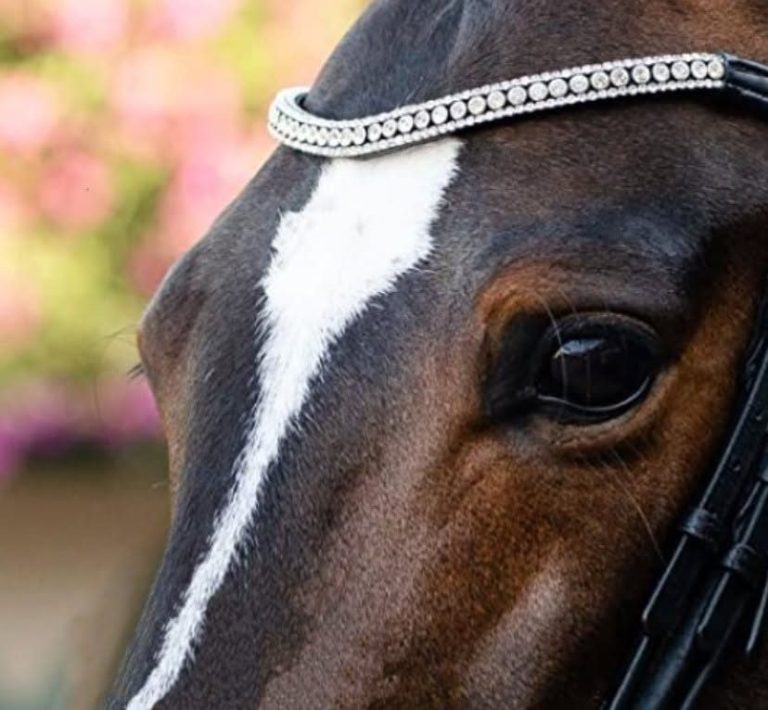
The browband is often treated as the decorative part of the bridle — the strap that carries the crystals or the coloured piping. It is easy to overlook, and many riders never think about its size once the bridle has been bought.
Yet the browband does an important structural job. It stops the headpiece sliding backwards down the neck, and in doing so it sets the position of everything that hangs from the headpiece: the cheekpieces, the noseband and, ultimately, the bit.
A browband that is the wrong length changes the whole bridle, and it does so in an area that pressure research has shown to be one of the most sensitive on the horse's head.
What the browband actually does
The headpiece of a bridle passes over the poll, just behind the ears. On its own, it would tend to slip backwards, particularly when the horse lowers its head or when rein pressure draws the bit back. The browband passes in front of the ears and connects to the headpiece on each side, holding it forwards in the correct position.
That makes the browband the anchor for the top of the bridle. When it is the right length, the headpiece stays where it should, and the cheekpieces hang straight down the face. When it is the wrong length, the headpiece moves, and the rest of the bridle moves with it.
Where the browband should sit
A correctly fitted browband lies across the frontal bone of the forehead, just below the base of the ears. It should not touch or press into the ears themselves, and the loops where it joins the headpiece should sit clear of the back of the ears. It should be level, sitting at the same height on both sides, and lie smoothly against the forehead without gaping or pressing in.
The area beneath and around the browband is not as passive as it looks. Branches of the nerves that supply sensation to the forehead and ears lie close to the surface here, along with small blood vessels supplying the area. The base of the ear is particularly sensitive, and it sits close to the temporomandibular joint, where the jaw meets the skull. Our article on bridle fit, facial nerves and bone structure explains this anatomy in more detail.
What the research shows
In a 2015 study published in the Journal of Equine Veterinary Science, Dr Rachel Murray and colleagues mapped the pressures beneath the bridles of competition horses.
One of the six peak pressure zones they identified was beneath the browband attachment, at the base of the ears — an area that corresponds closely to the temporomandibular joint. The team's redesigned bridle used padding and shaping to lift the bridle away from these points, and the horses showed freer movement as a result. You can read a detailed overview of the study on Horse Sport.
In other words, the place where the browband meets the headpiece is not a minor detail. It is one of the points where a bridle is most likely to cause discomfort.
When a browband is too short
A browband that is too short — the version that feels tight — pulls the headpiece forward against the back of the ears. The ears become crowded between the browband in front and the headpiece behind, and pressure builds at the base of the ears and around the temporomandibular joint. The cheekpieces are drawn forward at the top, so they no longer hang straight, and the browband itself may press across the forehead.
Horses respond to this in a variety of ways. Some shake or toss their heads, some resent having their ears handled or being bridled, some rub their heads, and many carry tension through the poll and jaw that makes it difficult for them to flex and soften. Red marks, rubs or hair loss at the base of the ears or along the line of the browband are common physical signs.
As horses mature, muscle up through the top of the neck or simply change shape over a season, a browband that once fitted well can become too short. It is one of the most common bridle problems, and one of the easiest to solve.
When a browband is too long
A browband that is too long can look perfectly acceptable. It lies flat, it does not look tight, and it often seems the kinder option. But it allows the headpiece to slide backwards behind the poll towards the wings of the atlas, and when that happens, the rest of the bridle follows.
The cheekpieces are pulled back at the top, so they no longer hang straight. The noseband shifts from its intended position. The bit can change height in the mouth. The whole bridle becomes less stable, moving with each stride and with every change in head position, and pressure moves around rather than staying evenly distributed. Riders sometimes compensate without realising, tightening the noseband or adjusting the cheekpieces to stop things moving, which can create new pressure elsewhere.
An overly long browband can also droop at the front and bounce against the forehead in work, which some horses find irritating.
Finding the right length
The right browband is long enough to allow the headpiece to sit comfortably behind the ears without pulling it forward, and short enough to stop the headpiece sliding back. In practice, that usually means a browband that sits snugly but comfortably — you should be able to slide a flat hand beneath it without forcing it, while the bridle stays stable when the horse moves its head.
Many riders loosen or lengthen a browband because a correctly fitted one looks a little snug, and in doing so they create a less stable bridle. Equally, many horses are wearing browbands that are clearly too short, because the bridle came with a standard size that does not suit their head. Browbands are available in a range of lengths, and replacing the browband alone is often enough to transform how a bridle fits.
Browband shape matters too
Length is not the only consideration. The shape of the browband changes how it sits, particularly around the ears.
A straight browband works well on many horses, but on a horse with a broad forehead or prominent ears it can still press at the attachment points.
A curved or shaped browband dips slightly in the centre and gives more room at the ears, which suits many horses better.
Some designs are deeper or padded to spread pressure across the forehead, and some anatomical bridles shape the browband and headpiece together to keep pressure away from the base of the ears. Our article on choosing the right anatomical bridle explores these options.
The attachment loops matter as well. Bulky loops, thick stitching or decorative fittings at the sides of the browband can all create focal pressure exactly where the research found it to be highest.
How the browband affects the bit
Because the cheekpieces hang from the headpiece, the browband indirectly affects where the bit sits.
A headpiece pulled forward or allowed to slide back changes the angle and effective length of the cheekpieces, which can raise or lower the bit, tilt it, or make it less stable in the mouth. When a horse is unsettled in the contact, the browband is worth checking alongside the bit itself.
Our article on why cheekpiece length and position are critical explains how this chain of adjustments works.
A simple browband check
With the bridle on and the horse standing quietly, start by looking at the ears. There should be visible space between the back of the ears and the headpiece, and the browband should not touch the ears at the front. Check that the browband is level and sits at the same height on each side, then slide a flat hand beneath it — it should go in without force, but the browband should not gape.
Look at the cheekpieces: do they hang straight down from the headpiece, or are they pulled forward or back at the top? Ask a helper to move the horse's head gently up, down and to each side, and watch whether the headpiece slides back or pulls into the ears.
After riding, check the base of the ears and the line of the browband for red marks, swelling, rubbing or hair loss. Any of these suggest the browband, or the bridle as a whole, needs adjusting.
A note on what this does and does not mean
A browband is only one part of the bridle, and it cannot fix a headpiece that is the wrong shape or a bridle that does not suit the horse's head. If a correctly sized browband still causes rubbing or the horse remains uncomfortable around the ears, the headpiece and overall bridle design should be looked at too.
And not every horse that dislikes having its ears touched has a browband problem. Ear sensitivity can have many causes, including ear mites, injury, headshaking and learned wariness. Persistent or sudden sensitivity around the ears or head should be checked by your vet.
Our article on headshaking in ridden horses explains when to seek veterinary advice.
Key takeaways
✔ The browband holds the headpiece in position, so it affects the cheekpieces, noseband and bit
✔ It should lie across the forehead just below the ears, level on both sides, and clear of the ears themselves
✔ Too short, and it pulls the headpiece into the back of the ears, creating pressure around the base of the ears and TMJ
✔ Too long, and the headpiece slides back, making the whole bridle unstable
✔ Research identified the browband attachment area as one of the bridle's peak pressure zones
✔ A flat hand should slide beneath a well-fitted browband without force, and the bridle should stay stable as the head moves
Want a professional eye on your horse's bridle?
If your horse is fussy about its ears, uneasy at bridling or carries tension through the poll, the browband is one of the first things worth checking — and one of the simplest to put right.
The Fitted Horse's bridle and bit fitting consultations assess the whole bridle, including browband length and shape, and recommend changes that keep your horse comfortable and the bridle stable.
Book a bridle fitting consultation →
Further reading: Bridle fit, facial nerves and bone structure | Signs your bridle may not fit correctly | The anatomical bridle revolution | Why cheekpiece length and position are critical | Bridle fit research overview (Horse Sport)