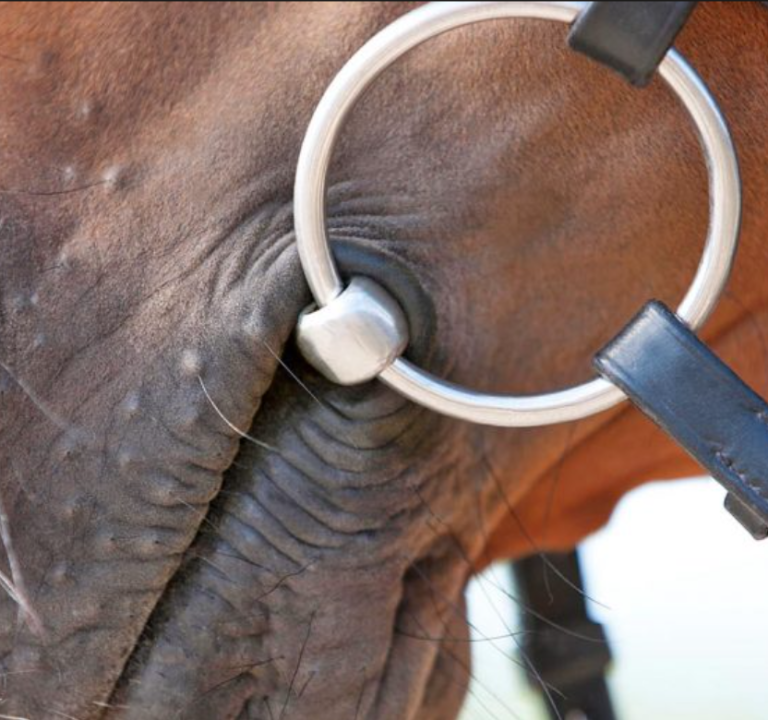
Almost every rider has been taught it at some point: adjust the cheekpieces until there are one or two wrinkles at the corner of the horse's mouth.
It is quick, easy to remember and needs no equipment, which is exactly why it has been passed down for generations.
The trouble is that it was always a shortcut, and it assumes that every horse's mouth is shaped the same way. They are not. Applied without thought, the rule leaves many horses with a bit that is too high and others with one that is too low.
Why the rule doesn't work for every horse
Wrinkles form when the bit draws the soft tissue at the corners of the lips upwards. How readily that tissue wrinkles depends on the horse's anatomy rather than on any fixed relationship with the bit.
Some horses have thick, fleshy lips and a short distance between the corner of the mouth and the front of the muzzle — sometimes described as a "short smile". These horses wrinkle very easily. With the bit sitting at exactly the right height, they may already show two or three wrinkles. Adjusted to show the "correct" number, the bit is often too low; adjusted to tidy up the extra wrinkles, it may be fine — but the wrinkles tell you very little either way.
Other horses have thin, tight lips that hardly wrinkle at all. With the bit correctly placed, they may show one faint wrinkle or none. If the cheekpieces are shortened until two wrinkles appear, the bit is pulled up into the corners of the mouth, stretching the lips and pressing the bit back towards the cheek teeth.
Some horses are also asymmetrical, with more wrinkling on one side than the other. Chasing an even number of wrinkles on both sides can leave the bit sitting unevenly on the bars, which is the opposite of what is wanted.
What actually matters: where the bit sits
The purpose of setting bit height is to place the mouthpiece on the bars, in the interdental space, clear of the teeth in front and behind and level from one side to the other. That is what determines whether the bit is comfortable and works as intended. Wrinkles are simply a side effect, and an unreliable one.
To assess bit height properly, gently lift the lips at each side of the mouth and look at where the bit is resting. Ask whether it is sitting on the bars, whether it is clear of the canines and the first cheek teeth, whether it is level on both sides, and whether the lips are lightly in contact with the bit rather than stretched or slack.
Our article on why cheekpiece length and position are critical covers adjusting the bridle once you know where the bit should be.
The cost of getting it wrong
A bit set too high stretches the corners of the mouth, can rub and split the lips, increases pressure at rest, and may restrict the horse's ability to move its jaw and swallow comfortably. A bit set too low is less stable, can knock against the canines, and invites the horse to put its tongue over the top.
Both can lead to fussing, head tossing, an unsettled contact and resistance that is easily mistaken for a training problem. Many horses go through bit after bit when the real issue is simply the height at which their existing bit has been set.
A better approach to bit height
Start with a bit of the correct width and thickness for the horse's mouth. Set the cheekpieces to a reasonable starting height, then lift the lips and check where the bit is sitting on the bars. Adjust each side until the bit is level and correctly placed, regardless of how many wrinkles appear. Then check it again under a light contact, because the bit draws back and up once the reins are taken up, as explained in our guide to assessing bit fit under contact.
Finally, watch the horse. A correctly placed bit usually shows in a quieter mouth, a softer expression and a more settled contact.
A note on what this does and does not mean
Wrinkles are not meaningless. Once you know where your horse's bit should sit, the wrinkle pattern at that height can be a useful visual reference for checking the bridle quickly each day. The problem is using a fixed number of wrinkles as the target for every horse.
Nor is this a criticism of anyone who has used the rule. It has been taught in good faith for generations. It simply does not account for the wide variation in horses' mouths that we now understand much better.
Key takeaways
✔ The number of wrinkles depends on the horse's lip shape and thickness, not just on bit height
✔ Fleshy-lipped horses wrinkle easily and may show several wrinkles at the correct height
✔ Thin-lipped horses may show no wrinkles when correctly fitted, so chasing two wrinkles pulls the bit too high
✔ The correct height places the bit on the bars, clear of the teeth and level on both sides
✔ Lift the lips to check bit position, then recheck under a light contact
✔ Once the correct height is found, the wrinkle pattern can serve as a quick daily reference for that horse
Not sure your horse's bit is at the right height?
If your horse fusses with the bit or the contact never feels settled, the height of the bit is one of the simplest things to check — and one of the most commonly overlooked.
The Fitted Horse's bit and bridle fitting consultations assess where the bit is actually sitting, at rest and under contact, and adjust the bridle to suit your horse's individual mouth.
Book a bit fitting consultation →
Further reading: Interdental space and bit position | Why cheekpiece length and position are critical | Assessing bit fit under contact | How mouth anatomy affects bit choice