
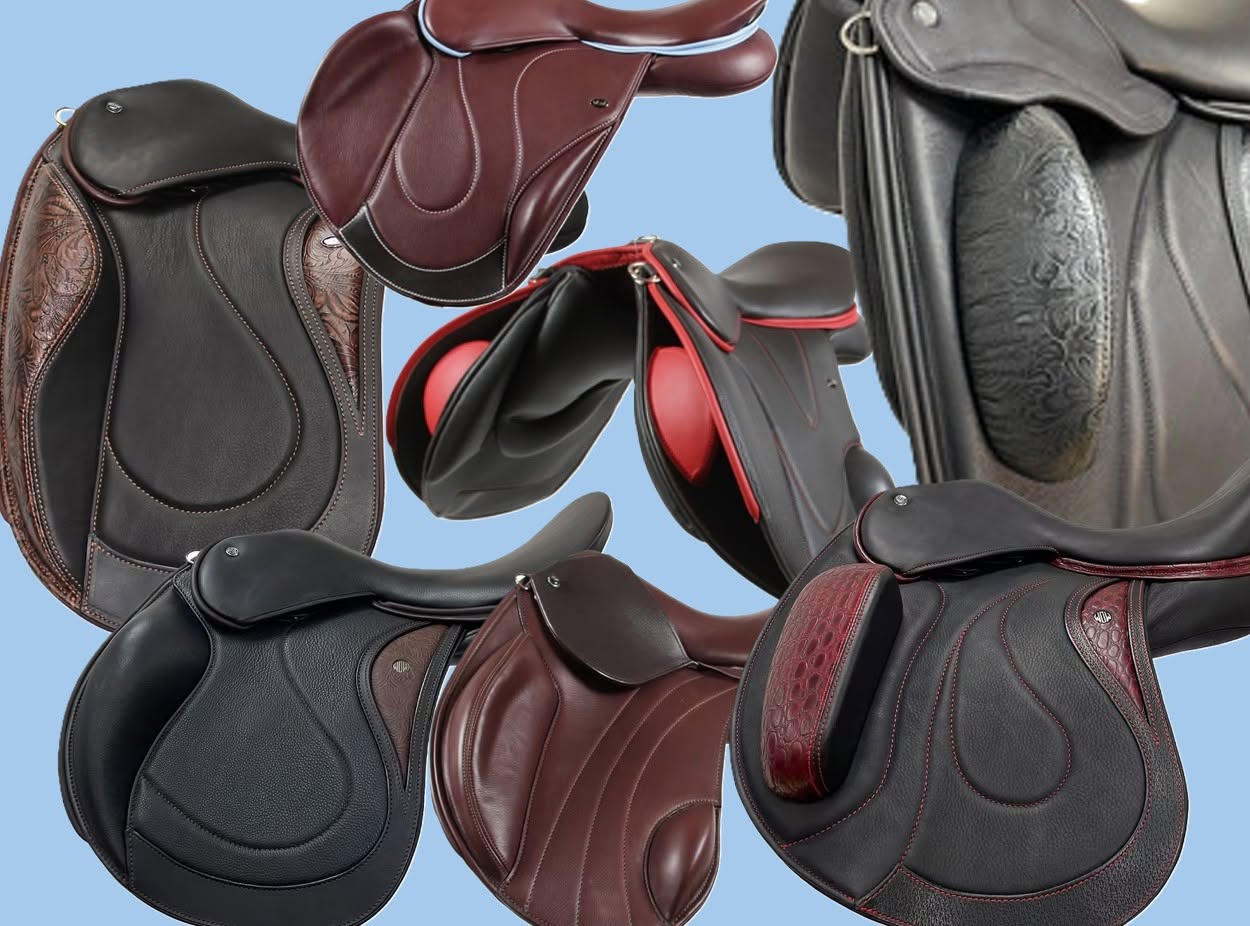
Your Saddle Flap Blocks Matter More Than You Think!
Here's something people don't talk about enough:
The knee block, thigh block, and calf block on your saddle flap directly affect WHERE your leg sits and HOW you ride.
Choosing the wrong one isn't just uncomfortable - it can actually create position problems that training can't fix.
First, let's understand what these do:
THE KNEE BLOCK
Supports your knee
Determines how far FORWARD your knee position is
Can be positioned forward (jumping style) or back (dressage style)
THE THIGH BLOCK
Supports your thigh
Affects how much forward/back support you get
Can be deep (lots of support) or shallow (more freedom)
THE CALF BLOCK
Supports your lower leg
Affects lower leg stability and position
Can be prominent (lots of contact) or minimal (less contact)
Together, they create your "seat pocket" - the shape that holds your leg in position.
Now here's where it gets interesting:
FORWARD-CUT BLOCKS (Jumping/Event saddles):
 Benefits:
Knee block positioned forward encourages jumping position
Creates security for jumping/cross-country
Supports forward folding motion
Natural position for athletic work
 Drawbacks:
Forces heel forward if you're not careful
Can make deep dressage seat uncomfortable
Too much support can restrict movement
Not ideal for collection work
Best for: Jumping, eventing, cross-country, riders who need security in forward position
VERTICAL BLOCKS (Dressage saddles):
Benefits:
Knee block positioned more back encourages vertical leg
Supports deep, secure dressage seat
Allows deep seat without excessive thigh pressure
Encourages heel under hip alignment
Works with collection
Drawbacks:
Can feel insecure if you jump
Doesn't support forward folding
Deep thigh block can feel restrictive
Not ideal for riders who need to shift weight forward
Best for: Dressage, flatwork, riders focused on vertical leg and collection
ALL-PURPOSE BLOCKS (Compromise position):
Benefits:
Moderate forward position (not extreme either way)
Works for multiple disciplines
Enough support without being restrictive
Suits riders who do mixed work
Drawbacks:
Compromise = not ideal for either discipline
Not forward enough for serious jumping
Not back enough for serious dressage
Middle ground doesn't always work well
Best for: Mixed riders, amateurs doing multiple things, riders who want versatility
DEEP vs SHALLOW BLOCKS:
DEEP THIGH/CALF BLOCKS:
Benefits:
More support and security
Keeps your leg underneath you
Good for nervous riders
Good for young/green horses
Clear position reference
Drawbacks:
Can feel restrictive to sensitive riders
Can prevent subtle movement adjustments
Might trap your leg in one position
Less freedom for independent leg control
Best for: Nervous riders, young/sensitive horses, riders who need structure
SHALLOW BLOCKS:
Benefits:
More freedom of movement
Allows subtle leg adjustments
Less restrictive feeling
Better for independent leg control
More room for different leg lengths
Drawbacks:
Less security feeling
Requires stronger leg stability
Doesn't hold your position for you
Can feel unstable for some riders
Best for: Experienced riders, independent leg position, riders who want freedom
YOUR BODY SHAPE MATTERS!
LONG FEMURS (long thigh bone):
Block positioning affects you more (longer distance from knee to hip)
May need blocks positioned differently than someone with short femurs
Knee block position is CRUCIAL
Standard blocks might not work - customization may help
SHORT FEMURS (short thigh bone):
Different leverage and angles
May find standard blocks work well
Proportionally different leg position
Flap length and block position work together
LARGER THIGHS:
Need more room under the thigh block
Too-narrow thigh block = constant pressure and discomfort
Block depth matters - shallow might be better than deep
Can't force yourself into a block designed for smaller build
SMALLER BUILD:
Small thigh blocks might feel unstable
Might benefit from deeper blocks for security
Proportions matter - standard sizing might not fit
Different customization needed
DIFFERENT HIP ANGLES:
Some people naturally sit more forward (anterior pelvic tilt)
Some naturally sit more back (posterior pelvic tilt)
Block positioning should support YOUR natural position, not fight it
Customisation can help match your anatomy
CONNECTION TO DISCIPLINE ALSO MATTERS!
Your discipline DEMANDS certain block positioning:
 Jumping - needs forward blocks for the jumping position and security
Dressage - needs vertical/back blocks for collection and deep seat
Eventing - needs compromise that works for both
Western - needs different balance entirely
Trail riding - security matters more than discipline-specific position
Trying to do jumping in a dressage-cut saddle? The forward blocks don't support your jumping position.
Trying to do dressage in a jumping saddle? The blocks force you too far forward.
WHAT MAKES GOOD FLAP BLOCKS:
Positioned correctly for YOUR discipline
Sized appropriately for YOUR body proportions
Deep/shallow balance that suits YOUR riding style
Calf block that supports YOUR lower leg position
Flap length that matches YOUR leg proportions
Overall that allows independent leg movement while providing necessary support
IF YOUR LEG POSITION FEELS WRONG:
It might not be YOUR position. It might be:
Knee block positioned wrong for your body
Thigh block too deep or too shallow
Flap length wrong for your proportions
Calf block not supporting your lower leg
Your leg position isn't a character flaw. Sometimes the saddle is just fighting you instead of supporting you.