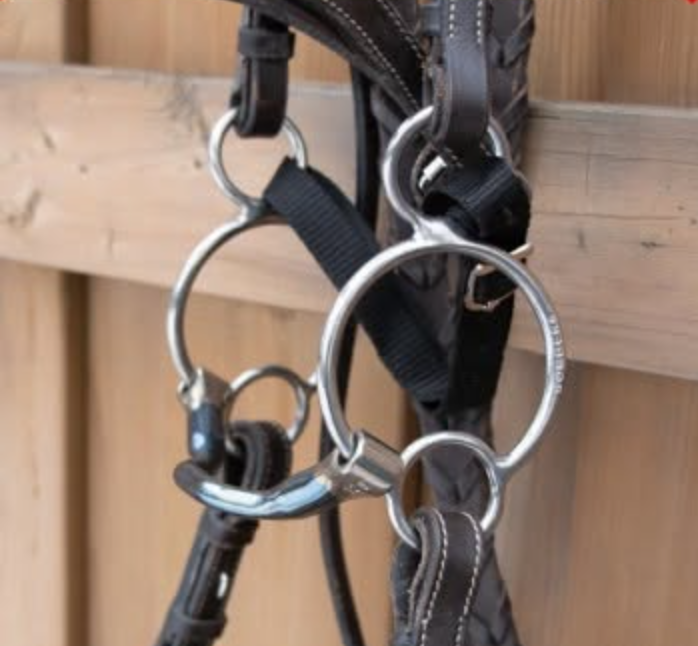
The Dutch gag — also called the continental, bubble or three- or four-ring gag — is one of the most widely used bits in the UK, particularly in show jumping and cross-country. It is often reached for as an everyday "bit more brakes" option, and it is very common to see one fitted without a curb strap.
In The Fitted Horse's experience, that missing strap is one of the most frequent reasons a gag feels stronger, and a horse more tense in it, than the bit's design would suggest.
How a gag bit works
On a Dutch gag, the bridle cheekpieces attach to the small ring at the top of the bit, and the reins attach to one of the rings below the mouthpiece. When the rein is taken up, the bit rotates around the mouthpiece. The mouthpiece lifts in the horse's mouth, and the top ring draws the headpiece down onto the poll.
The lower the rein is attached, the longer the lever and the stronger this effect. That is why many riders use two reins — one on the main snaffle ring for a direct action, and one on a lower ring for the gag action — so the two can be used separately and the gag only comes into play when needed. Traditional gags with sliding cheekpieces work in a slightly different way, but the principle of combining lift with poll pressure is the same.
Our article on snaffle and leverage bits explains this family of bits in more detail.
What a curb strap does
A curb strap is a leather strap that fastens to the top rings of the bit and lies in the chin groove. It limits how far the bit can rotate. As the rein is taken up, the strap comes into contact with the chin groove and acts as a stop, so the bit's action stays within a defined range.
It also introduces a small amount of chin groove pressure and helps keep the mouthpiece steadier in the mouth, which some horses find reassuring. It should be fitted so that it comes into play once the bit has rotated a moderate amount — not so tight that it acts as soon as the rein is touched, and not so loose that it never acts at all.
What happens when a gag over-rotates
Without a curb strap, there is nothing to stop the bit continuing to rotate as rein pressure increases. The cheeks can tilt well beyond their intended angle, and several things happen at once.
Poll pressure increases beyond what the bit was designed to apply, and keeps increasing with every stronger rein aid. The mouthpiece is drawn further up into the corners of the mouth, stretching and pinching the lips. The relationship between the rider's hand and what the horse feels becomes less predictable, because the bit's action is no longer within a consistent range.
The horse's response is often tension: through the jaw, the poll, the neck and the back. Some horses brace and lean; others become fussy, shake their heads or go behind the contact. A bit that is reasonably mild by design can start to feel harsh simply because its mechanism is not being controlled.
Why the strap is so often missing
In most cases, it is not a deliberate choice. Many gags are sold without a curb strap, many riders have never been shown one, and it is easy to assume it is an optional extra. Because the horse cannot tell us that the poll pressure is stronger than intended, the problem can go unnoticed for a long time — often until the horse becomes tense or resistant and the bit is blamed.
What to check if your horse is in a gag
Look first at whether a curb strap is fitted, running from the top ring on one side, through the chin groove, to the top ring on the other. If it is, check that it is flat, smooth and correctly adjusted. Then think about how your horse goes in the bit: whether it seems tense or braced, whether it fusses or tilts its head, and whether the bit feels stronger than you would expect.
It is also worth checking the rein position. A rein on the lowest ring gives the strongest leverage, and many horses go more happily with the rein higher up or with two reins.
A note on what this does and does not mean
This article is not a recommendation to use a gag. In The Fitted Horse's experience, relatively few horses genuinely need one, and many that are ridden in a gag go as well or better in a well-fitted snaffle once fit, dental and training factors have been addressed.
Nor is a curb strap a fix for a gag that does not suit the horse. Not every rider fits one, and published guidance describes it as an optional addition rather than a requirement. But where a gag is the right choice, The Fitted Horse recommends fitting a curb strap so that the bit works within a predictable range. Competition rules on gags vary between disciplines, so always check the current rules for your sport.
Key takeaways
✔ A Dutch or continental gag rotates when the rein is used, lifting the mouthpiece and applying poll pressure
✔ The lower the rein is attached, the stronger the leverage
✔ A curb strap fastens to the top rings and sits in the chin groove, limiting how far the bit can rotate
✔ Without one, a gag can over-rotate, increasing poll pressure and pinching the lips unpredictably
✔ Over-rotation often shows as tension, bracing, fussing or a bit that feels stronger than expected
✔ Few horses truly need a gag — but where one is used, a correctly fitted curb strap makes it clearer and fairer
Is your horse's bit working the way it should?
If your horse is in a gag and seems tense, braced or harder to ride than you would expect, the set-up of the bit may be part of the answer — or a different bit may suit them better.
The Fitted Horse's bit and bridle fitting consultations look at how your current bit is fitted and working, and whether a simpler option could give you the control you need with less pressure.
Book a bit fitting consultation →
Further reading: Snaffle and leverage bits explained | Understanding bit pressure | The complete guide to bit cheekpieces | The Dutch gag bit: how it works (Horse & Hound)