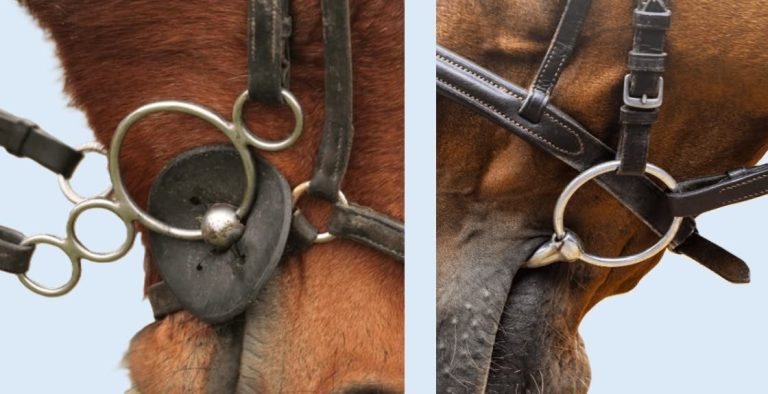
Every bit, however unusual its design, belongs to one of two families. It either acts directly, with the rein connected to the mouthpiece, or it acts through leverage, with a shank that multiplies the effect of the rider's hand. Understanding which family a bit belongs to is the first step in understanding what it is actually asking of the horse.
The distinction matters because the two families do not simply differ in strength. They communicate differently, place pressure on different parts of the head, and require different levels of training from both horse and rider.
What makes a bit a snaffle
A snaffle is defined by how the rein connects to the mouthpiece, not by what the mouthpiece looks like. On a snaffle, the rein ring is the same ring that the mouthpiece passes through, so a rein aid travels in a straight line into the horse's mouth. There is no lever arm between the hand and the mouth, nothing to multiply the pressure, and no mechanism to bring the poll or chin groove into play.
The easiest way to identify one is to trace the line from the rein to the mouthpiece. If there is no separate shank, no curb chain and no lever arm in between, you are looking at a snaffle — whether it has a single joint, a lozenge, a straight bar or any other mouthpiece.
This is also why a "Dutch gag" or "Kimblewick" is not a snaffle, even though many people use them as everyday bits. Once the rein can be attached below the mouthpiece, the bit has leverage.
How a snaffle acts in the mouth
When the rein is taken up, a snaffle generally moves slightly backwards and upwards in the mouth. Where the pressure then lands depends on the mouthpiece, the cheekpiece, and — just as importantly — the anatomy of the individual horse.
The mouth is not a flat, uniform space. The tongue, bars, palate and lips all respond differently to pressure. A thin, straight mouthpiece presses more directly onto the bars. A single-jointed mouthpiece can fold into the tongue and, in a horse with a low palate, rise towards the roof of the mouth. A double-jointed mouthpiece with a lozenge or link tends to wrap more evenly over the tongue. A thicker or flatter design spreads pressure over a larger area, provided the horse has room for it.
The cheekpiece changes the bit's stability. A loose ring allows the mouthpiece to move and gives the horse something to play with, but can also slide. An eggbutt or D-ring holds the mouthpiece steadier, and a full cheek adds lateral stability, helping to keep the bit central when turning. Each of these interacts with the mouthpiece in its own way; our complete guide to bit mouthpieces and complete guide to bit cheekpieces look at the options in detail.
In short, the mouth shapes the bit's action just as much as the bit shapes the mouth. The same snaffle can feel quite different in two horses.
Is the snaffle always the gentle option?
Mechanically, the snaffle is the mildest family of bit, because it has no leverage. That is a useful starting point, but "mildest family" does not mean every snaffle is kind.
A thin or sharp-edged mouthpiece can be severe. A thick mouthpiece in a mouth with little space can be uncomfortable. A twisted or textured mouthpiece concentrates pressure. And any snaffle that is the wrong width or thickness, or sits at the wrong height, can cause real discomfort. The choice of mouthpiece and the quality of the fit matter just as much as the bit family itself.
How leverage bits work
On a leverage bit, the rein does not attach to the ring around the mouthpiece. Instead, it attaches to a shank — an arm that extends below the mouthpiece. Above the mouthpiece, an upper cheek connects to the bridle. When the rein is taken up, the shank rotates, the mouthpiece acts on the mouth, the upper cheek draws the headpiece down onto the poll, and, where a curb chain or strap is fitted, it tightens into the chin groove.
Because the shank acts as a lever, the pressure the horse feels is greater than the pressure in the rider's hand. The longer the lower shank in relation to the upper cheek, the greater the multiplication. A small movement of the hand therefore produces a much larger effect, and it is spread across several parts of the head rather than the mouth alone.
Leverage bits come in many forms. The Weymouth (curb) is used alongside a bradoon — a small snaffle — in the double bridle, with the bradoon sitting above the curb. The pelham combines snaffle and curb actions in a single mouthpiece, usually ridden with two reins or a rounding. Gag bits work slightly differently, with the cheekpieces running through the bit rings so that the bit slides up in the mouth while pressure is applied to the poll. What they share is that they bring additional pressure points into play.
Where each bit applies pressure
A snaffle acts mainly within the mouth: on the tongue and bars, on the corners of the lips through the rings, and potentially on the palate, depending on the mouthpiece and the horse's anatomy. It applies little or no poll pressure.
A leverage bit acts on all of those areas and adds the poll and, with a curb chain, the chin groove. For a horse trained to understand these signals, the combination can allow very refined communication. For a horse that is not, it can be confusing, and poll pressure in particular is something many horses resist.
Our article on understanding bit pressure looks at these pressure points in more depth.
When leverage is appropriate
There are legitimate reasons to use leverage. The double bridle is part of the tradition of advanced dressage and is permitted from certain levels under British Dressage rules. Some disciplines, such as Western riding, are built around curb bits. And some horses, correctly introduced, genuinely go well in a leverage bit.
In every case, though, leverage is an addition rather than a replacement for training. It works well when the horse has been taught to understand it, the rider has the skill and independent seat to use it lightly, and there is a genuine reason for it. Without those conditions, it is easy to create excessive pressure without realising, and the bit can become a substitute for schooling rather than a refinement of it.
The introduction matters too. A horse that has only ever been ridden in a snaffle has no reason to understand poll or curb pressure, and a sudden change can create confusion and resistance rather than better control.
A note on what this does and does not mean
This is not an argument that leverage bits are cruel or that snaffles are always kind. A well-fitted double bridle, used by a skilled rider on a horse trained to it, can be a very quiet way to communicate. A poorly chosen or badly fitted snaffle can cause considerable discomfort.
What it does mean is that the starting point should be the simplest bit that works. In The Fitted Horse's experience, most horses are happy in a well-chosen, well-fitted snaffle for their whole working lives.
If a stronger bit seems necessary, it is always worth first ruling out fit, dental and comfort issues, and considering whether the underlying problem is one of training rather than equipment.
Our guide to choosing the right bit for the rider explores this further.
Key takeaways
✔ A snaffle has no leverage: the rein attaches to the same ring as the mouthpiece, so pressure goes directly into the mouth
✔ A leverage bit has a shank that multiplies the rein aid and adds poll and, with a curb chain, chin groove pressure
✔ Whether a bit is a snaffle depends on how the rein connects, not on the type of mouthpiece
✔ The snaffle is the mildest family of bit, but mouthpiece design and fit still decide how comfortable it is
✔ Leverage can be appropriate for trained horses and skilled riders, but it refines training rather than replacing it
✔ Most horses go well in a correctly fitted snaffle; rule out fit, dental and training issues before reaching for more leverage
Not sure whether your horse's bit is right for them?
Whether your horse is in a snaffle and seems unsettled, or you are wondering whether a leverage bit is really needed, a professional assessment can help.
The Fitted Horse offers bit and bridle fitting consultations that look at your horse's mouth, your riding and your goals, and recommend the simplest bit that genuinely suits them.
Book a bit fitting consultation →
Further reading: The complete guide to bit mouthpieces | The complete guide to bit cheekpieces | Understanding bit pressure | The double bridle | British Dressage tack and equipment guide